No Product Added

By : Shah Electronics
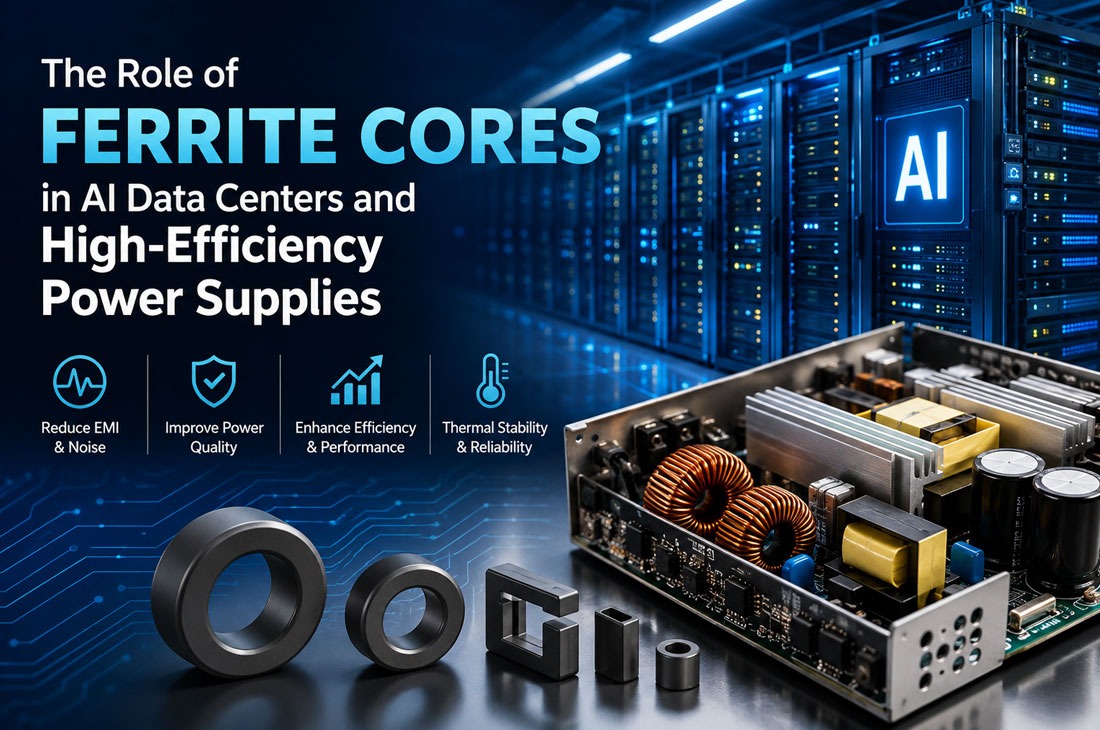
Artificial intelligence isn't just changing software it's reshaping hardware demands from the ground up. Behind every AI model training run, every GPU cluster, and every high-density server rack lies a power delivery system working overtime to keep things running cool, stable, and efficient. And at the heart of that system sits a component many people overlook: the ferrite core.
As data centers scale to support AI workloads, power supply design has become a make-or-break factor in performance, reliability, and energy costs. In this blog, we'll break down why ferrite cores matter more than ever, how they support high-efficiency power conversion, and what to look for when sourcing them for demanding applications.
Why Power Efficiency Is the New Data Center Priority
AI servers consume dramatically more power than traditional computing equipment. GPUs and accelerators draw heavy, fluctuating current loads, and every inefficiency in the power path translates into wasted energy, excess heat, and higher operating costs at scale.
This is where magnetic components and ferrite cores specifically become critical. A well-designed power supply doesn't just convert voltage; it does so with minimal loss, tight regulation, and excellent thermal behavior, even under the rapid switching frequencies that modern AI hardware demands.
What Is a Ferrite Core?
A ferrite core is a magnetic component made from a ceramic compound of iron oxide combined with other metallic elements such as manganese, zinc, or nickel. Unlike solid metal cores, ferrite core material is engineered to offer high magnetic permeability alongside low electrical conductivity a combination that dramatically reduces eddy current losses.
This makes ferrite cores ideal for transformers, inductors, and chokes used in switch-mode power supplies (SMPS), which are the backbone of virtually every server power supply component used in modern data centers.
How Ferrite Cores Support AI Data Center Power Supplies
1. Minimizing Core Losses at High Frequencies
Modern AI data center power supplies operate at increasingly high switching frequencies to shrink component size and improve conversion speed. A standard iron core would suffer significant energy loss at these frequencies due to eddy currents and hysteresis. A high frequency ferrite core, by contrast, is specifically engineered to maintain low core loss even above hundreds of kilohertz helping power supplies stay compact, efficient, and cooler.
2. Improving Thermal Performance
Heat is one of the biggest enemies of dense server infrastructure. Excess core loss doesn't just waste energy it generates heat that has to be managed through additional cooling, adding cost and complexity. Ferrite cores, with their low-loss characteristics, help reduce the thermal burden on power supplies, allowing servers to run more reliably even in tightly packed AI racks.
3. Enabling Compact, High-Density Designs
As data centers pack more compute power into smaller footprints, every component needs to do more with less space. Ferrite core materials allow engineers to design smaller transformers and inductors without sacrificing performance a crucial advantage for high-performance computing environments where rack space is at a premium.
4. Supporting Stable Power Conversion Under Variable Loads
AI workloads are not static; GPU power draw can spike and drop rapidly during training and inference cycles. Ferrite-core-based inductors and transformers help maintain stable magnetic performance under these variable load conditions, contributing to cleaner power delivery and fewer voltage fluctuations downstream.
Ferrite Core Materials: Choosing the Right Fit
Not all ferrite cores are created equal. Material selection depends on the specific application:
Choosing the correct magnetic core material directly impacts efficiency, size, and long-term reliability which is why sourcing from an experienced manufacturer matters as much as the design itself.
Ferrite Cores as Essential Power Electronics Components
Beyond data centers, ferrite cores are foundational power electronics components across renewable energy systems, EV chargers, telecom infrastructure, and industrial power supplies. Their unique blend of magnetic efficiency and low electrical loss makes them indispensable wherever high-frequency power conversion is required and AI infrastructure is quickly becoming one of the largest growth areas for this demand.
Why It Matters for AI Infrastructure Going Forward
As AI models grow larger and data centers race to support higher compute density, power efficiency will only become more important not less. Every fraction of a percentage point saved in conversion efficiency compounds across thousands of servers, translating into real reductions in energy consumption and cooling costs.
Ferrite cores may be small, but their role in enabling efficient, high-frequency, thermally stable power conversion makes them one of the quiet enablers of the AI revolution.
At Shah Electronics, we manufacture precision ferrite cores engineered for demanding applications from AI data center power supplies to industrial power electronics. Explore our range of high-performance solutions here: Ferrite Coils by Shah Electronics.
FAQs
1. What is the main function of a ferrite core in a power supply? A ferrite core's primary function is to store and transfer magnetic energy efficiently in transformers and inductors, while minimizing energy loss during high-frequency power conversion.
2. Why are ferrite cores preferred over iron cores in AI servers? Ferrite cores have much lower electrical conductivity than iron, which significantly reduces eddy current losses at high switching frequencies — making them far more efficient for modern AI server power supplies.
3. What is the difference between MnZn and NiZn ferrite cores? MnZn ferrites work best for lower-frequency, higher-power applications, while NiZn ferrites are better suited for higher-frequency uses like EMI suppression and high-speed power conversion.
4. How do ferrite cores help with thermal management in data centers? By reducing core losses, ferrite cores generate less heat during operation, which lowers the cooling burden on power supplies and helps servers run more reliably under heavy AI workloads.
5. Are ferrite cores used only in AI data centers? No. While they play a growing role in AI infrastructure, ferrite cores are also widely used in telecom equipment, EV chargers, renewable energy systems, and general power electronics.
6. Where can I source high-quality ferrite cores for power supply design? Shah Electronics offers a range of precision-engineered ferrite cores suited for high-frequency, high-efficiency applications. Explore the full lineup here: Ferrite Coils by Shah Electronics.
© 2025. Shah Electronics. All Rights Reserved. Terms of Use Privacy Policy Cookie Policy
Terms of Use
Privacy Policy
Cookie Policy
© 2025. Shah Electronics. All Rights Reserved.
Powered by WEBMANTRA