No Product Added

By : Shah Electronics
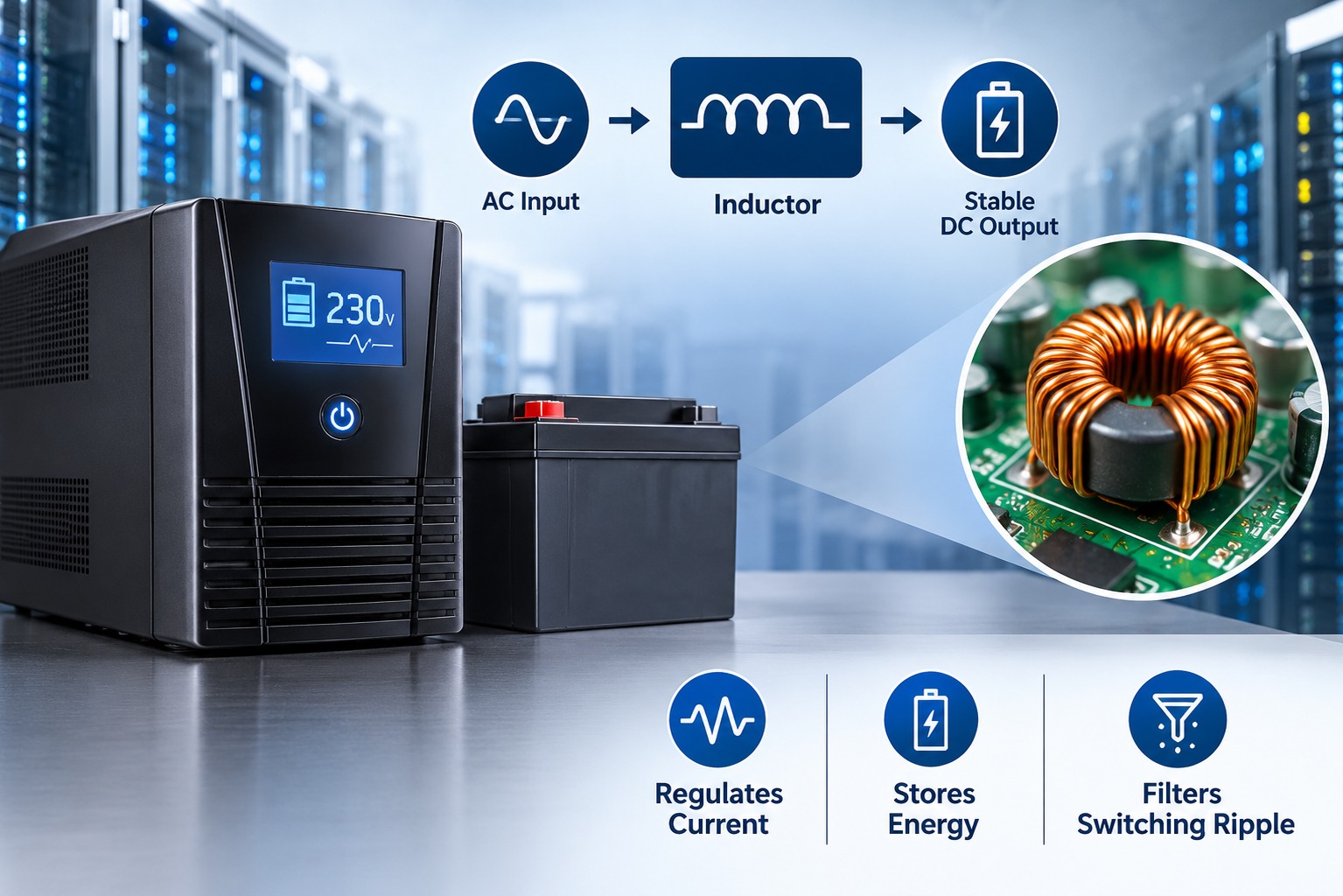
When the lights go out in a hospital, a data centre or a factory floor, nobody wants to notice. The screens stay on, the machines keep running, and the switch to battery power passes unseen. That smooth handover is the UPS doing its job.
But a UPS is only as dependable as the small parts inside it. Among the most important are the magnetic components, and the humble inductor is one of the hardest working of them all. Let's look at what an inductor for UPS system designs actually does, and why choosing the right one matters.
An inductor is a coil of wire, often wound on a magnetic core, that stores energy in a magnetic field when current flows through it. Its key habit is that it resists sudden changes in current. That one simple behavior makes it useful for smoothing, filtering and controlling power throughout a backup power system.
You will see it called a power inductor, a UPS inductor or a UPS choke coil, depending on the job it does and who is describing it.
A UPS has to do several things at once: charge batteries, convert DC to clean AC, filter noise and protect connected equipment. Inductors support nearly every stage. Together with transformers, current transformers and EMI filtering parts, they form the core of the UPS power supply components that keep things stable.
An energy storage inductor holds energy briefly during each switching cycle and releases it to the next stage. This is how converters step voltage up or down efficiently, without wasting power as heat.
Inductors limit how quickly current can rise. This protects switches such as MOSFETs and IGBTs from sharp spikes and keeps current under control when the load suddenly changes, for instance when a large server rack powers up.
Fast switching creates small, rapid fluctuations in voltage and current, known as ripple. A current filtering inductor works with capacitors to smooth this out, so sensitive loads receive steady power.
When the mains fails, the battery voltage often needs to be raised to a higher DC level before it is converted to AC. A DC-DC converter inductor handles this boost stage. During battery charging, a similar inductor helps control charging current precisely. Poor inductors here waste battery energy, and that shortens runtime.
The inverter turns DC into AC. At its output, inductors form a filter that shapes the switching waveform into a smooth sine wave. This keeps harmonics low and protects equipment that is sensitive to distorted power.
Many UPS units include a power factor correction stage at the input. A boost inductor shapes the input current so the UPS draws power cleanly from the mains. This improves efficiency and helps meet power quality standards.
A UPS choke coil also reduces electrical noise, both from the UPS and from the supply. Common-mode chokes in particular help the unit meet EMC requirements and avoid disturbing nearby devices.
Different jobs call for different designs:
There is no single best option. The right choice depends on current, frequency, size limits and heat.
Industrial UPS systems operate under tougher conditions than a home unit: higher power, longer duty cycles, dust, heat and vibration. Inductors in these systems need to handle large currents and wide temperature ranges without drifting.
In all of these, a failed component is not just an inconvenience. It can mean lost production, lost data or a safety risk.
Keep these points in mind:
For about three decades, Shah Electronics has manufactured and supplied ferrite coils, SMPS transformers, current transformers and a wide range of power-saving electrical products. That experience with magnetic components helps us understand what UPS makers need: parts that stay cool, stay stable and keep working through years of standby duty.
Learn more about our UPS magnetic components and solutions, or send us your specifications and our team will help you find the right fit.
1. What does an inductor do in a UPS system?
It stores energy, regulates current and filters ripple, which helps the UPS convert power efficiently and deliver clean, stable output.
2. What is the difference between a UPS inductor and a UPS choke coil?
The terms overlap. "Inductor" is the general name, while "choke" usually describes a coil used to block or filter unwanted current or noise.
3. Where are inductors used in a UPS?
They are used in DC-DC converters, inverter output filters, PFC stages and EMI filters.
4. Why is a DC-DC converter inductor important for backup power?
It lets the UPS boost battery voltage efficiently when the mains fails, so more battery energy reaches the load and runtime improves.
5. What happens if a UPS inductor saturates?
Inductance drops suddenly, current spikes, and the converter can overheat or fail. This is why correct current rating and core selection matter.
6. Which inductor type is best for UPS systems?
It depends on the stage. Ferrite suits high-frequency stages, powder cores suit high DC current, and common-mode chokes suit noise filtering.
7. Do industrial UPS systems need special inductors?
They often do. Higher power, heat and continuous operation call for robust insulation, good thermal design and consistent quality.
8. Can Shah Electronics supply custom UPS inductors?
Shah Electronics supplies a wide range of ferrite coils and magnetic components. Share your electrical and mechanical requirements with our team for a suitable solution.
You rarely think about the inductor inside a UPS until something goes wrong, and that is how it should be. A well-chosen inductor for UPS system use quietly stores energy, steadies current and cleans up ripple, so your backup power works exactly when it is needed. Matching the right inductor to each stage is one of the simplest ways to improve efficiency and reliability.
Looking for dependable magnetics for your UPS design? Visit Shah Electronics or contact our team today.
© 2025. Shah Electronics. All Rights Reserved. Terms of Use Privacy Policy Cookie Policy
Terms of Use
Privacy Policy
Cookie Policy
© 2025. Shah Electronics. All Rights Reserved.
Powered by WEBMANTRA