No Product Added

By : Shah Electronics
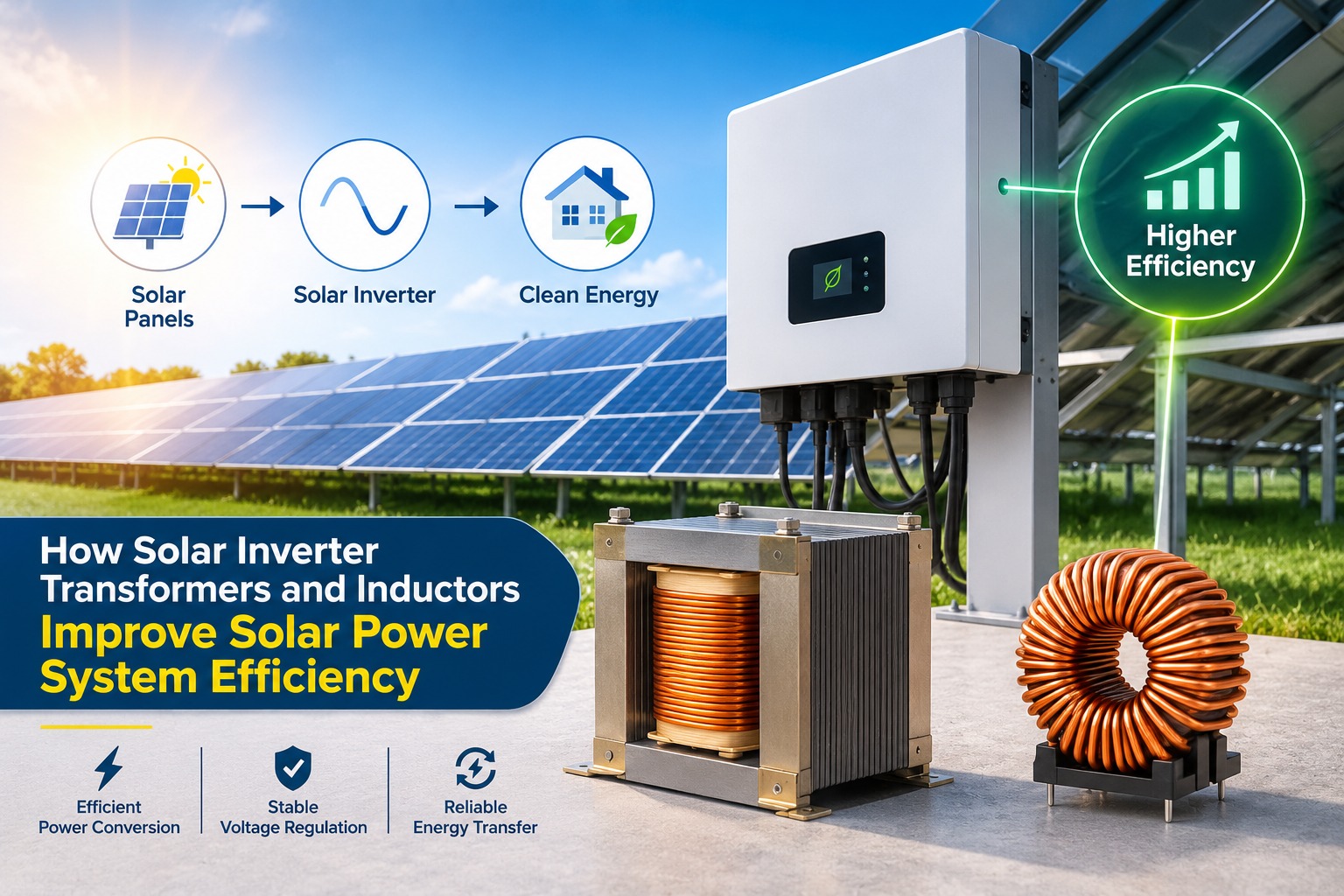
Ask anyone who owns a solar plant what they care about most, and the answer is usually the same: how much of the sunlight I'm paying for actually turns into usable power?
Panels get most of the attention. But between the panels and your appliances sits the inverter, and inside it, a handful of magnetic parts decide how much energy is kept and how much is lost as heat. The solar inverter transformer and the solar inverter inductor are two of the most important of these.
Let's look at what they do, where they are used, and what to look for when choosing them.
Solar panels produce direct current (DC) at a voltage that shifts with sunlight and temperature. Your home, factory or the grid needs stable alternating current (AC). The inverter handles this solar energy conversion in stages:
Every stage depends on solar inverter components that store, transfer and filter energy. The magnetic ones, transformers and inductors, are where careful design pays off most.
Rather than one job each, these components share five important roles.
A solar power transformer steps voltage up or down so each stage works at its best level. Panel voltage swings through the day, but the output must stay steady. Transformers and boost inductors help hold the DC bus and the AC output within the required limits, even when sunlight changes quickly.
A high-frequency transformer moves power from the DC side to the output side with minimal loss. Inductors also act as short-term energy stores, taking in energy during one part of the switching cycle and delivering it in the next. Low-loss cores and well-wound coils mean more of the energy reaches the load.
A power inductor for solar inverter designs limits how fast current can rise. This protects switches such as MOSFETs and IGBTs from sharp current spikes, and makes it possible to control current accurately in both the boost stage and the grid-connected output.
Fast switching creates ripple, small rapid fluctuations in current and voltage. A well-chosen solar inverter inductor works with capacitors to flatten this ripple. Less ripple means less stress on components, less heat and lower losses.
At the output, inductors form filters that clean the waveform and reduce harmonics and switching noise. Transformers add electrical isolation, which supports safety and helps limit leakage currents. Together they deliver cleaner power that meets grid requirements.
Inverter efficiency is the sum of many small losses. Magnetic components influence it in clear ways:
A fraction of a percent saved on conversion, repeated every sunny hour for 25 years, adds up to real energy and real money.
Home systems are usually small rooftop installations with single-phase string or hybrid inverters. Here, compact high-frequency transformers and inductors help keep inverters light, quiet and efficient. Homeowners care about steady output, low noise and years of trouble-free running, which depends on good thermal design.
Offices, malls, schools and warehouses typically use larger string or three-phase inverters. These systems feed a building's load for long hours every day, so even small efficiency gains reduce electricity bills noticeably. Reliable magnetics also reduce downtime, which matters for businesses that depend on predictable savings.
Factories, large rooftops and ground-mounted plants run at higher power levels, often in hot, dusty environments. Here transformers and inductors face heavy continuous loads and wide temperature swings. Strong insulation, thermal stability and consistent batch quality become essential, because a single failed component can interrupt a large share of the plant's output.
Solar equipment lives outdoors or in hot enclosures. It faces temperature swings, dust, humidity and changing loads from morning to evening. Good solar magnetics are designed for:
When choosing a transformer or inductor, ask how it behaves at high temperature, not just at room temperature on a datasheet.
Whether you are an inverter manufacturer or an EPC company sourcing parts, check these points:
The same principles apply across renewable energy components. Wind converters, battery storage systems and hybrid inverters all rely on transformers and inductors to move energy efficiently and safely.
For about three decades, Shah Electronics has been manufacturing and supplying ferrite coils, SMPS transformers, current transformers and a wide range of power-saving electrical products. That background in magnetics helps us understand what inverter makers actually need: efficient designs, dependable thermal behaviour and parts that keep performing year after year.
Take a look at our solar inverter transformer range, and send us your specifications if you need something tailored to your design.
1. What is a solar inverter transformer?
It is a magnetic component inside a solar inverter that transforms voltage, provides electrical isolation and transfers power efficiently between stages of the converter.
2. Do all solar inverters use transformers?
No. Transformer less inverters omit it to gain efficiency and reduce weight. Others use a high-frequency or line-frequency transformer for isolation. The choice depends on the design, safety rules and market.
3. What does a solar inverter inductor do?
It stores energy, controls current, smooths ripple and filters the output, helping the inverter produce clean, stable power with fewer losses.
4. How do transformers and inductors help with voltage regulation?
Transformers set the right voltage levels between stages, while inductors in boost and buck circuits help hold the DC bus steady as panel voltage changes through the day.
5. Why are high-frequency transformers used in solar inverters?
Higher switching frequencies allow smaller, lighter magnetics, which reduces the size and cost of the inverter while still providing isolation.
6. How do magnetic components affect solar inverter efficiency?
Losses in the windings and core turn directly into heat. Lower losses mean more solar energy reaches the load, and cooler operation helps the inverter last longer.
7. Are the requirements different for residential and industrial systems?
Yes. Residential systems prioritise compact size and quiet operation, while industrial systems need higher power handling, stronger thermal performance and consistent quality for continuous heavy duty.
8. Can Shah Electronics supply custom solar inverter transformers?
Shah Electronics supplies a wide range of transformers and ferrite coils. Share your electrical and mechanical requirements with our team and they will advise on a suitable solution.
The best solar systems are not just about big panels. They depend on the small, hard-working parts that turn raw DC into clean, usable AC with as little waste as possible. A well-designed solar inverter transformer and solar inverter inductor regulate voltage, control current, reduce ripple and condition power, whether the system sits on a home rooftop or powers a factory.
Looking for dependable magnetics for your inverter design? Visit Shah Electronics or contact our team today.
© 2025. Shah Electronics. All Rights Reserved. Terms of Use Privacy Policy Cookie Policy
Terms of Use
Privacy Policy
Cookie Policy
© 2025. Shah Electronics. All Rights Reserved.
Powered by WEBMANTRA