No Product Added

By : Shah Electronics
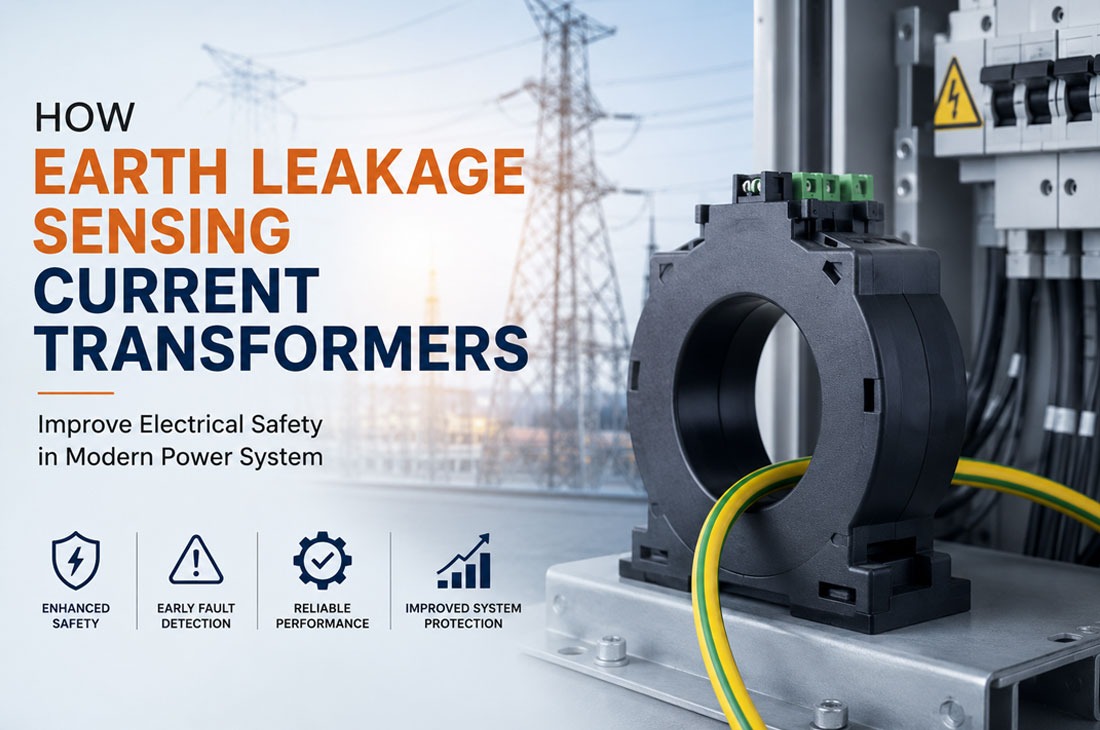
Envision this: a factory floor humming with machines, an EV charging station buzzing with activity, or a rooftop solar setup quietly feeding power into the grid. Now imagine a tiny fault a nicked wire, a bit of moisture, a worn insulation layer silently leaking current into places it shouldn't go. You wouldn't see it. You wouldn't hear it. But it could shock someone, fry expensive equipment, or start a fire before anyone notices.
This is exactly the kind of invisible risk that an Earth Leakage Sensing Current Transformer is built to catch.
If you work anywhere near power distribution panels, industrial automation lines, or EV charging infrastructure, you've probably heard the term thrown around. But what does it actually do, and why has it become such a non-negotiable part of modern electrical safety design? Let's break it down in plain language.
What Exactly Is an Earth Leakage Sensing Current Transformer?
At its core, an Earth Leakage Current Transformer is a specialized sensor that constantly watches the current flowing through a circuit. Under normal, healthy conditions, the current going out through the live conductor and the current coming back through the neutral should be perfectly balanced what goes out comes back.
The moment that balance is disturbed, even slightly, it means current is escaping somewhere it shouldn’t through a damaged cable, faulty appliance, or a person accidentally touching a live part. That escaped current is called leakage current, and detecting it early is the whole point of the game.
Unlike a standard Current Sensing Transformer that simply measures load current for metering or monitoring, an earth leakage version is tuned specifically to pick up on these tiny imbalances often in the milliampere range long before they become dangerous.
How Does It Actually Work?
The working principle is refreshingly simple, even though the engineering behind it is precise. Both the live and neutral conductors pass through the transformer's core. Because current flowing in opposite directions creates opposing magnetic fields, a perfectly balanced circuit produces a net magnetic field of zero.
But when there's a leakage fault say, current escaping to earth through a faulty motor casing that balance breaks. The mismatch generates a small but detectable magnetic field, which the transformer picks up and converts into a signal. This signal gets passed along to a relay or protection device, which can trip the circuit in milliseconds.
This is the foundation of Residual Current Detection and Ground Fault Detection systems used across homes, industries, and renewable energy setups today. It's fast, it's reliable, and it doesn't require the fault current to be large to trigger a response that’s exactly why it works so well for protecting human life, where even small currents can be fatal.
Why This Matters More Than Ever
Electrical systems today are more complex, more connected, and frankly more demanding than they were even a decade ago. Between EV charging stations drawing high currents overnight, industrial automation systems running unattended, and solar inverters feeding power both ways, the margin for undetected faults has shrunk.
Here's what a good Leakage Current Sensor brings to the table:
Where These Sensors Are Making the Biggest Impact
EV Charger Safety EV chargers push significant current over long charging cycles, often outdoors and exposed to moisture. An earth leakage sensing transformer built into the charger's protection circuit is what allows it to shut down instantly if a fault develops a critical part of any serious EV Charger Safety design.
Industrial Automation & Protection Systems Factories run dozens of motors, drives, and control panels simultaneously. A single insulation fault in one machine shouldn't be allowed to become a safety hazard for the whole floor. This is where Industrial Protection Systems rely heavily on leakage sensing to isolate faults quickly and keep operations running safely.
Renewable Energy Systems Solar inverters and battery storage systems deal with unconventional current flows compared to traditional grid power. Ground fault detection here isn't optional it’s essential for preventing arc faults and protecting both equipment and installers.
Power Distribution Networks From substations to distribution panels, leakage current monitoring helps utilities catch degrading insulation across long cable runs before it turns into an outage or a safety incident.
Building Reliable Electrical Safety Solutions
At the end of the day, no single component makes a system "safe” but earth leakage sensing current transformers are one of the most important building blocks of any serious Electrical Safety Solutions strategy. They're quiet, unglamorous, and working constantly in the background which is exactly what you want from a safety device.
If you're designing or upgrading a system that needs dependable leakage and fault detection, it's worth looking into transformers engineered specifically for this purpose rather than repurposing general-use current transformers. You can explore Shah Electronics' range of current transformers built for precision leakage sensing across industrial, EV, and renewable energy applications.
FAQs
1. What is the difference between a Current Transformer and an Earth Leakage Sensing Current Transformer? A standard current transformer measures load current for metering or protection against overload. An earth leakage version specifically detects the tiny imbalance between live and neutral current caused by leakage to ground, making it far more sensitive to fault conditions.
2. How much leakage current can these sensors detect? Depending on the design and sensitivity rating, these transformers can typically detect leakage currents in the milliampere range sensitive enough to catch faults well before they pose a serious safety risk.
3. Are earth leakage sensing transformers required by electrical codes? Many industrial, commercial, and EV charging installations now require residual current or ground fault protection as part of safety compliance, making these transformers a standard part of modern electrical design.
4. Can these transformers be used with both AC and DC leakage currents? It depends on the transformer type. Some are designed purely for AC leakage detection, while others (often used in EV and solar applications) are built to detect both AC and DC leakage components for broader protection.
5. Where should an earth leakage sensing current transformer be installed? It's typically installed at the point where the live and neutral (or phase) conductors can be passed through the transformer core together commonly at distribution panels, EV charger circuits, or individual equipment feeders needing dedicated protection.
© 2025. Shah Electronics. All Rights Reserved. Terms of Use Privacy Policy Cookie Policy
Terms of Use
Privacy Policy
Cookie Policy
© 2025. Shah Electronics. All Rights Reserved.
Powered by WEBMANTRA